How to find your hair type
- Wash and air dry. Wash with shampoo and a light conditioner, then let your hair dry naturally with no gel, cream or heat, so you see its real pattern.
- Check the curl pattern. Look at the lengths, not the roots or a single strand, and pick straight, wavy, curly or coily, then the closest A, B or C description.
- Test thickness and density. Hold one strand next to sewing thread, then part your dry hair and see how much scalp shows.
- Answer the porosity question. Think about how your hair takes conditioner or oil: slowly, steadily or fast with frizz soon after.
- Read your result. See your type from 1A to 4C with your thickness, density and porosity, plus a simple routine and cuts that suit it.
What is my hair type?
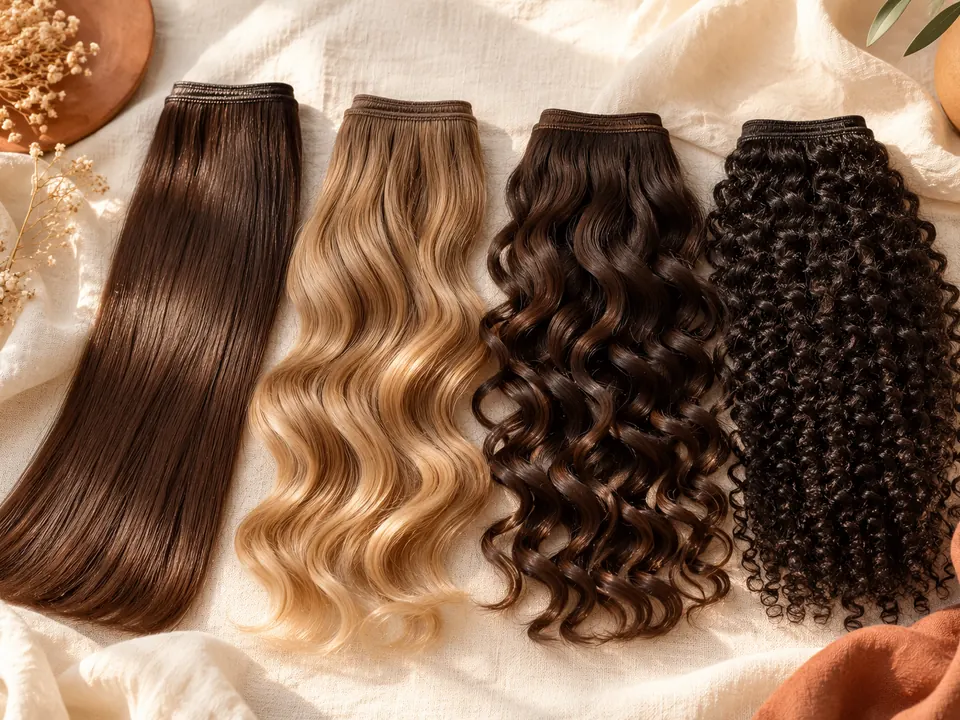
Hair types are usually described with the system popularized by stylist Andre Walker, which sorts hair into four families by curl pattern. Type 1 is straight, type 2 is wavy, type 3 is curly and type 4 is coily. Each family splits into A, B and C, from the loosest to the tightest pattern. So 2A is a soft, barely there wave and 4C is a tight zigzag coil with lots of shrinkage.
Curl pattern is only part of the story, though. Two people with 3B curls can need very different products if one has fine, low porosity hair and the other has coarse, high porosity hair. That is why this quiz also checks strand thickness, density and porosity. Your curl pattern tells you how a cut will behave, and the face shape finder tells you which cut will flatter you, so the two together give your stylist a clear brief.
Hair type chart
| Type | Pattern | What it looks like |
|---|---|---|
| 1A, 1B, 1C | Straight | No curl, from pin straight and fine to straight with a slight bend |
| 2A, 2B, 2C | Wavy | S shaped waves, from loose and soft to deep and defined from the roots |
| 3A, 3B, 3C | Curly | Defined ringlets, from chalk sized loops to tight pencil sized corkscrews |
| 4A, 4B, 4C | Coily | Tight coils and zigzags with lots of shrinkage |
Worked example: reading a 2B result
Say your hair dries in clear S shaped waves that start around the mid lengths and frizz a little. In the quiz you pick Wavy, then 2B. A strand feels about as thick as sewing thread (medium), you see some scalp along your parting (medium density), and conditioner soaks in and keeps your hair soft for a while (medium porosity).
Your result is 2B wavy hair, medium thickness, medium density, medium porosity. The routine that follows: a light curl cream or mousse on soaking wet hair, scrunch, then air dry or diffuse, and avoid brushing once dry. If the same waves soaked up oil fast and frizzed within hours, the result would switch to high porosity, and the advice would add a sealing cream and protein treatments.
Hair type by look and feel
| If your hair | You are probably |
|---|---|
| Dries flat and smooth, won't hold a curl | 1A or 1B |
| Has a soft bend you can brush out | 2A |
| Forms clear S waves from the mid lengths | 2B |
| Waves from the roots and frizzes easily | 2C |
| Makes loops about the width of sidewalk chalk | 3A |
| Makes springy ringlets about the width of a marker | 3B |
| Coils into tight springs that shrink a lot | 4A, 4B or 4C |
What is hair porosity?
Porosity is how easily your hair absorbs and holds moisture, and it depends on how open the outer cuticle layer is. Low porosity hair has a tightly closed cuticle, so water beads on it and products sit on top. High porosity hair has a raised cuticle, often from bleaching, heat or genetics, so it drinks up moisture and loses it just as quickly. Medium porosity sits in the happy middle.
A quick at home check is the float test: drop a clean, product free strand into a glass of room temperature water. If it floats for several minutes, your porosity is probably low. If it sinks slowly, it is medium, and if it sinks straight away, it is high. The absorption question in the quiz is usually more reliable, because oils left on the strand can skew the float test.
Thickness and density are not the same
Thickness is the width of a single strand, while density is how many strands grow on your head. You can have fine strands with high density, which looks full but tangles easily, or coarse strands with low density, which feel thick but show more scalp. Knowing both helps you choose cuts and products: fine hair suits lightweight mousses, while dense, coarse hair can handle rich butters and creams.
Once you know your type, find styles made for it in our guides to curly pixie cuts, long wavy hairstyles and loc styles, and track your length goals with the hair growth calculator.