What this tool does and when to use it
This calculator counts wallpaper the way decorators do: it works out how many full height strips each roll gives, how many strips your walls need, then the rolls to buy plus one spare from the same batch. It works for a whole room, one feature wall or a chimney breast, in feet with US rolls or in meters with European rolls, and it allows for pattern repeat.
How to calculate how much wallpaper you need
Area based estimates often come up short with wallpaper, because each roll is cut into full height strips and the leftover piece at the end of a roll is often too short to use. The calculator above works the way decorators do, strip by strip.
- Strip length. Take the wall height and add about 4 inches (10 cm) for trimming at the ceiling and skirting. For patterned paper, add one pattern repeat so each strip can be lined up with the last.
- Strips per roll. Divide the roll length by the strip length and round down. A 33 foot roll gives three full strips for an 8 foot wall, because each strip is 8 feet plus trim and the leftover piece is too short.
- Strips needed. Measure the total width of the walls, subtract doors, and divide by the roll width. Round up.
- Rolls needed. Divide strips needed by strips per roll and round up. Then add one spare roll.
Standard wallpaper roll sizes
| Type | Width | Length | Area |
|---|---|---|---|
| US single roll | 20.5 in | 33 ft | About 56 sq ft |
| US double roll | 20.5 in | 66 ft | About 112 sq ft |
| European roll | 53 cm | 10.05 m | About 5.3 sq m |
| Wide roll | 68 to 70 cm | 10 m | About 7 sq m |
Many US papers are priced per single roll but only sold as double rolls, so check the listing before you order.
How many rolls of wallpaper do I need? Common rooms
These come straight from the calculator with standard US single rolls (20.5 inches by 33 feet), plain or random match paper, and one door in each room. Every count already includes the spare roll.
| Room or wall | Wall height | Strips | Strips per roll | Rolls to buy |
|---|---|---|---|---|
| Small bathroom, 5 x 8 ft | 8 ft | 14 | 3 | 6 |
| 10 x 10 ft room | 8 ft | 22 | 3 | 9 |
| 10 x 12 ft room | 8 ft | 24 | 3 | 9 |
| 10 x 12 ft room | 9 ft | 24 | 3 | 9 |
| 12 x 12 ft room | 8 ft | 27 | 3 | 10 |
| 12 x 14 ft room | 8 ft | 29 | 3 | 11 |
| One wall, 8 ft wide | 8 ft | 5 | 3 | 3 |
| One wall, 10 ft wide | 8 ft | 6 | 3 | 3 |
| One wall, 12 ft wide | 8 ft | 8 | 3 | 4 |
In metric, a 4 x 3.5 m room with 2.4 m walls and one door needs 27 strips of standard 53 cm European paper. A 10.05 m roll gives 4 strips, so that is 7 rolls, or 8 with a spare. A 3 m feature wall needs 6 strips: 2 rolls, buy 3.
How pattern repeat changes the count
A repeat only costs you a roll when it pushes the strip length past a whole strip per roll. With 8 foot walls and a 21 inch repeat, each strip is about 10 feet, a 33 foot roll still gives 3 strips, and a 12 x 12 room still needs 10 rolls. Raise the ceiling to 9 feet and use a 24 inch repeat, and each strip becomes about 11 feet 4 inches: now a roll gives only 2 strips and the same room jumps to 15 rolls. In metric, a 64 cm repeat on a 2.4 m wall drops a European roll from 4 strips to 3. Always enter the repeat from the label before you order.
What is a pattern repeat?
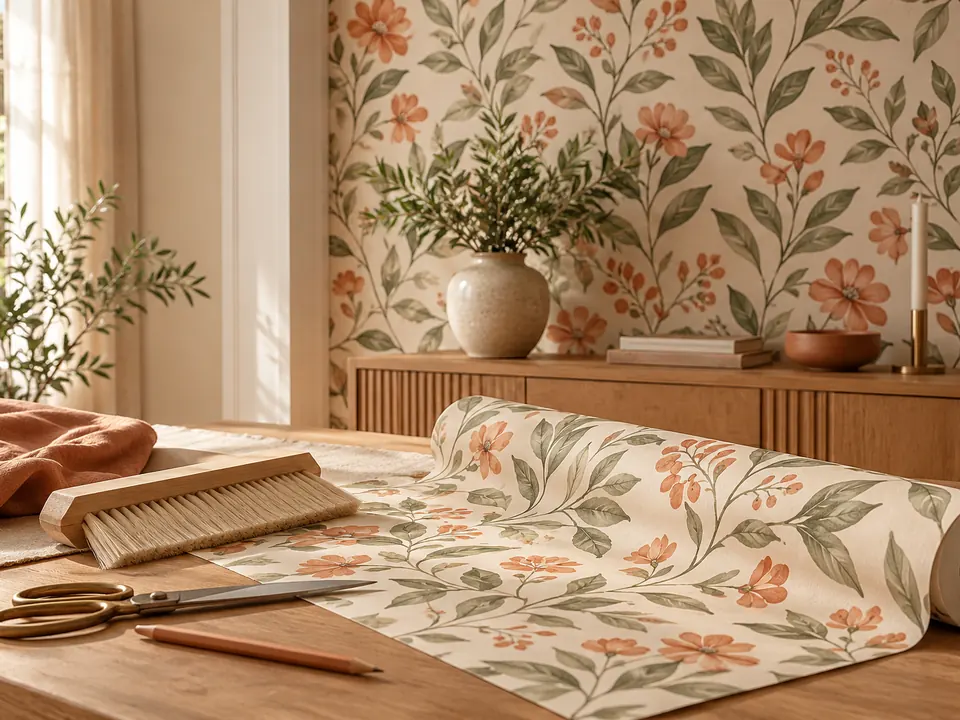
The pattern repeat is the vertical distance before the design starts again. Large, bold patterns can have repeats of 20 inches or more, which means extra waste on every strip. Plain papers and random match designs have no repeat, so you waste very little. A drop match pattern also staggers each strip by half a repeat, but the waste works out much the same as a straight match.
Chimney breasts, stairs and peel and stick
- Chimney breast: switch to feature wall and enter the front width plus both side returns as one width. The strips around a fireplace are short, but cutting them from full strips is the safe way to count.
- Hall, stairs and landing: stairwell walls change height from top to bottom. Enter the tallest drop as the wall height so every strip is long enough. You will have offcuts for the shorter strips along the stairs, so the count errs on the safe side.
- Peel and stick wallpaper: it is sold in panels or rolls of many sizes. Enter the panel width as the roll width and the panel length as the roll length. If the maker tells you to overlap the seams, take that overlap off the width first.
Feature wall or whole room?
A single feature wall is a quick, budget friendly way to add drama, and it is the perfect place for a bold pattern behind a bed or sofa. Switch the calculator to feature wall and enter just that wall's width. For more ideas, see our bedroom decor ideas and gallery wall ideas, and match the rest of the room with the color palette generator.